Believe it or not, there are some really amazing structures sprinkled throughout the cosmos. I’m not talking about structures, like alien ships or monuments or what have you, but naturally occurring phenomenon. These take the shapes of nebulae, which are just collections of space dust and gas molded into a system of sorts.
There are too many to go through. Some may strike a nerve and look familiar from a science book or compilation calendar you saw at Barnes and Noble. But The Cosmic Companion brings up a structure that I haven’t heard of, and sounds very cool.
It goes by ESO 137-001, but for convenience we’ll just call it the jellyfish galaxy.
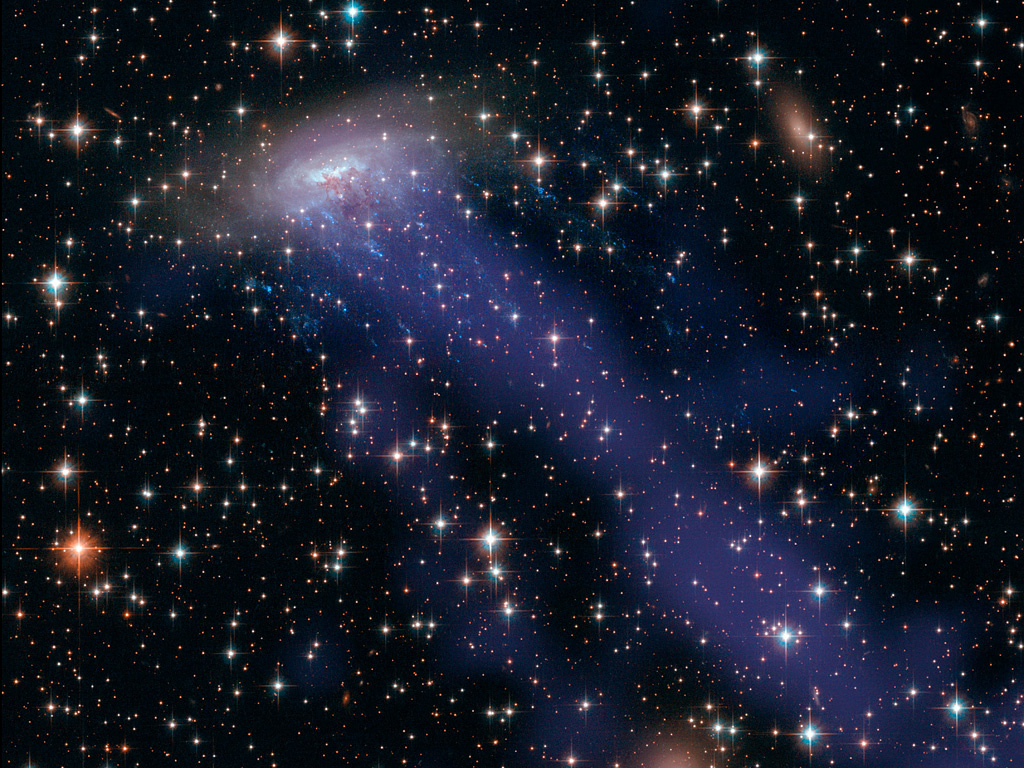
source: The Cosmic Companion
A spiral galaxy like our own, its tentacles stretch across 260,00 light years, emitting ultraviolet and blue light. What’s unusual about this is that, similar to our own galaxies formation eons ago, it went through a period of hot and cold. New stars and other celestial matter formed, cooled then settled. When new matter was introduced, it began to push that older matter out, a combination of old and new.
Besides the integrity and appearance of the galaxy, there’s one idea in here that should blow anyone’s mind:
James Maynard, The Cosmic Companion
“When the light we see today from ESO 137–001 left its home, it was the beginning of the Triassic Period on Earth, when all the continents were huddled together into the Pangaea supercontinent, and dinosaurs were just starting to rule the world.”
Light years are something that I don’t think people really understand, and I still struggle with it myself, because it sounds simple but the implications holds much more weight. Light years, to put it simply, is how long it would take a sources light to reach us. The thing is, since stars are so far away, by the time we see them, or by the time their light reaches us, they may already moved via our earths orbit, or they may have already died.
So to think that something we found has been giving off light since the time of dinosaurs, is something pretty profound.

 It's All Out There