After reading Move over dark matter, here comes the photon mass, I originally thought “great, as if it couldn’t get any more complicated…” But that is just the dismissive part of me talking. We should want space to get more complicated, because it only gets more exciting! This is yet another new theory about the functions of our galaxy and universe, and while the pool continues to get crowded, it brings up a completely obvious variable that might’ve have been over looked the entire time.
A recap
As we know by now, dark matter and dark energy are properties that for decades have been seen as the building blocks for our cosmos. Only now, after further recent research with hypothetical models of our universal model, it’s being proposed that they might not even be real. The universe has also been observed to be expanding at a rate faster than anticipated, and now our own Milky Way galaxy is making us scratch our heads.
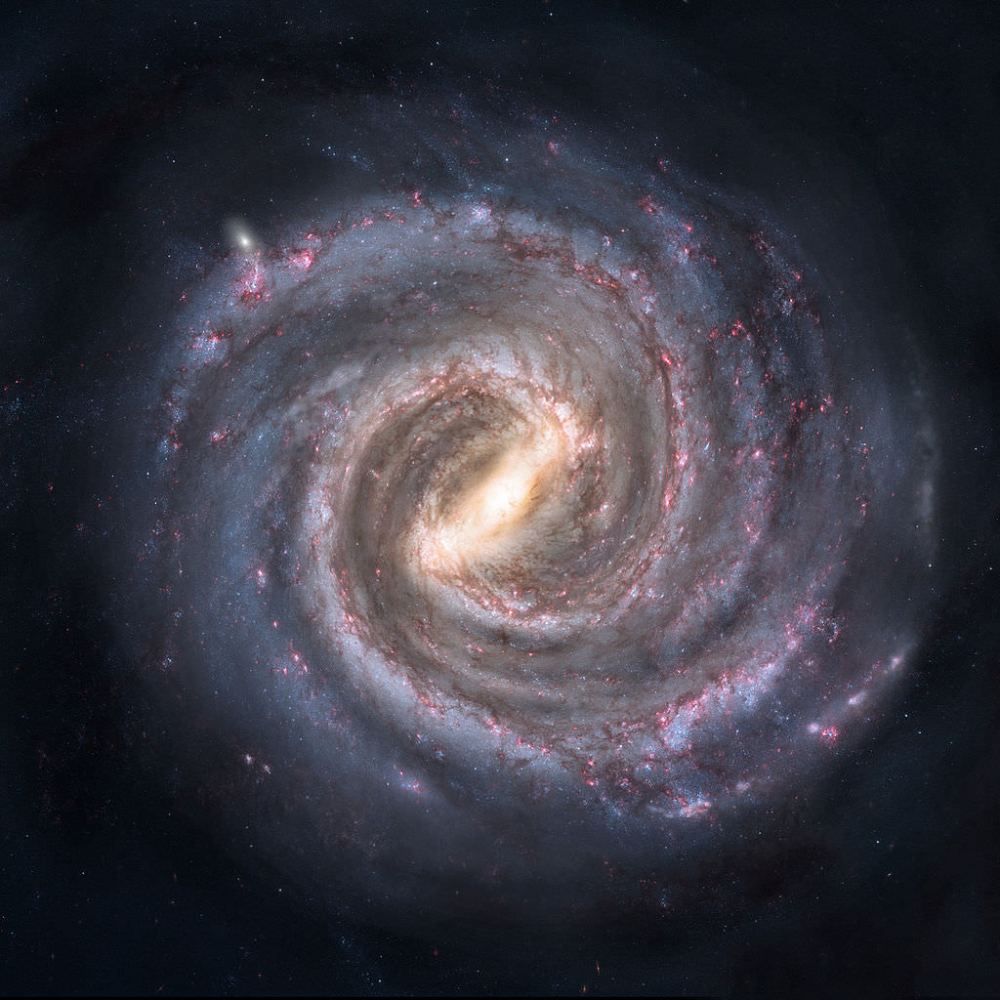
Stars at the middle and outer most portion of the galaxy are rotating at the same rate as the stars within the center. Dark energy as we know it is the force propelling the universe, expanding indefinitely. But that also would mean that the stars the further they get away from the source would slow down, and this does not seem to be the case.
So something else other than what we know of is having some kind of influence on our galaxies behavior, and by extension, our universes behavior. A team of physicists have come up with a simple but mind blowing idea.
See the light
Professor Dmitri Ryutov, Dmitry Budker and Victor Flambaum have presented the idea that photon particles-light particles-are responsible for effecting galaxy rotations and the spread of stars.
The basic idea is that while they are infinitely small, they are collected in such large masses that they could, theoretically, present forces that could effect gravity of celestial bodies. It makes sense, but like every other mysterious force, it’s hard to observe directly.
Why this is so important, is because of some other material I’ve read that goes into the idea that light and matter are an extension of our consciousness. Existing as raw probability matter, our conscious then breaks these down as light particles and photon waves, which then breaks those down instantaneously into the material spaces we occupy or see. Have you ever thought about what happens to the grocery store when you leave it? How do you know it’s still there if you aren’t there to observe it, to build it?
So then the question becomes a bit more personal than we expected. Rather than asking about what these forces mean for our galaxy and universe, it now becomes a question of how do these forces effect our own existence?
We fail to really notice the world around us, taking little things for granted . The color of the grass, the sun as it shines, leaving shadows across the pavement or how it spreads out across a tablecloth through a window. These all now seem to be deceptive observations. Color is just distribution of light. Shadows are just distribution of light. This kitchen space itself (theoretically) is just distribution of light. Maybe we ourselves, are just distribution of conscious light.


